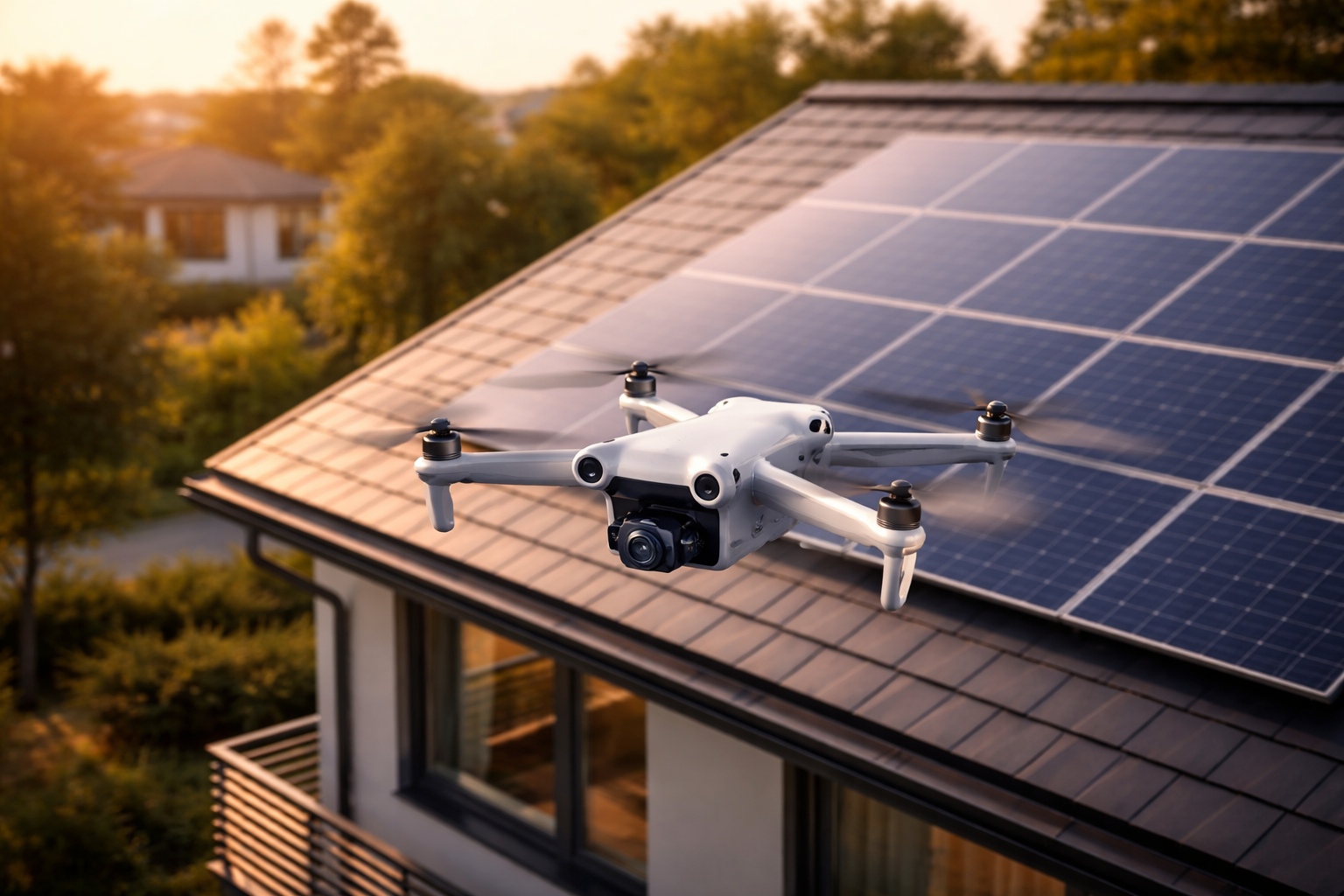
Thermal drone inspections have moved from a niche technology to a mainstream industrial tool in just a few years. Across energy, construction, agriculture, and public safety, organizations are replacing slow and dangerous manual inspections with faster, safer, and more accurate drone-based thermal imaging. The numbers behind this shift are significant — and growing every year.
This article looks at where the thermal drone inspection market stands in 2026, what is driving its growth, which industries are adopting it fastest, and how the competitive landscape is taking shape. All market data cited in this article is sourced from independent research firms and linked below.
Market Size at a Glance
$2.77B
Thermal drone inspection market value in 2024
Source: Market Research Future
13.1%
Projected annual growth rate through 2035
Source: Market Research Future
$10.7B
Projected thermal drone inspection market value by 2035
Source: Market Research Future
19%
Broader drone inspection market CAGR through 2030
Source: The Business Research Company
To put these numbers in context — the broader drone inspection and monitoring market was valued at approximately $16.4 billion in 2024 and is projected to reach $38.2 billion by 2030, according to Research and Markets. Thermal imaging represents one of the fastest-growing segments within that larger market, driven by its unique ability to detect problems invisible to standard cameras.
Why Thermal Drone Inspections Are Growing So Fast
The growth of this market is not accidental. Several converging forces are pushing organizations across industries to adopt thermal drone inspections at an accelerating rate.
Aging Infrastructure
According to Mordor Intelligence, more than 70% of North American transmission assets predate 1985. Aging infrastructure requires more frequent inspection to prevent failure, and traditional manual inspection methods — which involve workers climbing structures or using scaffolding — are costly, slow, and dangerous. Thermal drones compress inspection cycles from weeks to days while keeping workers safely on the ground.
Falling Sensor and Hardware Costs
The price of thermal imaging sensors has dropped significantly over the past decade. Mass production and improvements in manufacturing have made thermal cameras accessible to a much wider range of operators, including small businesses and independent inspectors. This cost reduction is a primary driver of market growth identified by Mordor Intelligence in their 2025 inspection drone market analysis.
Renewable Energy Expansion
Solar farms and wind turbine installations are multiplying worldwide. Both require regular thermal inspections — solar panels to identify faulty cells and hot spots, wind turbines to detect mechanical issues before they cause costly downtime. According to Fact.MR research, investments in renewable infrastructure inspections are one of the primary growth drivers for the thermal drone sector through 2025 and beyond.
AI and Automated Analysis
Artificial intelligence is transforming what organizations can do with thermal drone data. Computer vision models can now detect cracks, corrosion, and thermal anomalies with up to 85% accuracy, according to Mordor Intelligence, converting raw imagery into actionable maintenance reports within minutes. This automation dramatically reduces the cost of analysis and makes thermal inspections practical for a wider range of organizations.
Regulatory Support
Governments in North America, Europe, and Asia-Pacific are establishing clearer frameworks for commercial drone operations. As noted by Market Research Future in their thermal drone inspection market report, regulatory frameworks supporting drone use in inspection sectors are bolstering industry confidence and accelerating adoption.
Industries Driving Demand
⚡
Energy & Utilities
Power line inspection, transformer monitoring, and solar farm maintenance. One of the largest and fastest-growing segments.
🏗️
Construction
Heat loss detection, moisture mapping, structural diagnostics, and building envelope assessments.
☀️
Solar Energy
Identifying faulty panels, hot spots, bypass diode failures, and shading issues across large arrays.
🌾
Agriculture
Crop health monitoring, irrigation assessment, and pest detection using temperature variation analysis.
🚒
Public Safety
Fire detection, search and rescue operations, and post-disaster infrastructure assessment.
🏢
Real Estate & Insurance
Roof inspections, building diagnostics, and insurance claims assessment using thermal imaging.
North America currently holds the largest share of the global drone inspection market, according to The Business Research Company's 2026 market report. However, Asia-Pacific is growing rapidly, driven by urbanization, infrastructure expansion, and government investment in smart city projects in China, Japan, South Korea, and India.
Key Trends Shaping the Market in 2026
- AI-powered defect detectionAutomated analysis platforms are reducing the time between inspection and actionable insight from days to minutes. Machine learning models trained on millions of thermal images are now standard in professional inspection workflows.
- Beyond Visual Line of Sight (BVLOS) operationsRegulatory momentum behind BVLOS rules is enabling larger-scale autonomous inspection missions, particularly for pipeline, coastline, and transmission line monitoring.
- Drone-as-a-Service (DaaS) business modelsRather than purchasing drones outright, many organizations are contracting thermal inspection services on demand. This model lowers the barrier to adoption and is expanding the total addressable market.
- Multispectral and sensor fusionLeading platforms are combining thermal imaging with LiDAR, RGB cameras, and gas sensors into single payloads. This multi-layer approach provides richer data and reduces the number of flights required per inspection.
- Cloud-based reporting and real-time streamingInspection data is increasingly processed in the cloud and delivered as live dashboards, allowing asset managers to monitor conditions remotely and respond to anomalies in real time.
Where DJI Fits in the Thermal Inspection Market
DJI is identified as one of the key players in the global inspection drone market by multiple research firms including Market Research Future and The Insight Partners. DJI's position in the thermal inspection market spans two distinct segments: consumer and prosumer drones used for general visual inspection tasks, and purpose-built enterprise platforms designed for professional thermal imaging operations.
On the enterprise side, DJI's Matrice series paired with Zenmuse thermal payloads is deployed by utility companies, public safety agencies, solar farm operators, and infrastructure managers worldwide. These platforms combine high-resolution thermal sensors with advanced AI analysis, long flight times, and weather-resistant airframes suited to demanding inspection environments.
On the consumer and prosumer side, DJI's mainstream lineup — including the Mavic, Air, and Mini series — does not include built-in thermal cameras. However, these drones are widely used for visual inspection work such as roof documentation, construction site monitoring, and real estate photography where standard RGB imaging is sufficient.
Key Market Players Beyond DJI
While DJI holds a dominant position in the broader drone market, the thermal inspection segment also includes several specialized manufacturers worth noting:
- Teledyne FLIROne of the world's leading thermal imaging sensor manufacturers, whose cameras are integrated into many professional drone platforms including DJI's own enterprise systems.
- Autel RoboticsOffers thermal-capable enterprise drones competing directly with DJI's Matrice lineup.
- ParrotEuropean manufacturer with professional thermal drone platforms used in agriculture and public safety.
- SkydioUS-based manufacturer focused on autonomous inspection drones, gaining significant ground in US government contracts where restrictions on Chinese-manufactured drones apply.
Market concentration remains high, with DJI maintaining a dominant share of total drone shipments globally. However, regulatory pressures in the United States — particularly restrictions on Chinese-manufactured drones in government contracts — are creating openings for US-based manufacturers in the professional inspection segment.
What This Means for the Market
The growth of the thermal drone inspection market creates real opportunity for drone operators, inspection businesses, and asset managers. Demand for qualified thermal inspection operators is growing faster than supply across energy, construction, and solar sectors. Regulatory clarity is improving in major markets, reducing uncertainty for businesses building inspection service offerings. AI-powered analysis tools are compressing the time between inspection flight and actionable report from days to minutes — lowering the skill barrier for new entrants to the market.
Summary
The thermal drone inspection market is one of the clearest growth stories in the broader drone industry. Valued at $2.77 billion in 2024 and projected to reach $10.7 billion by 2035, it is expanding at a consistent double-digit rate driven by aging infrastructure, renewable energy growth, falling hardware costs, and advancing AI analysis tools. DJI occupies a significant position in this market as one of the world's leading drone manufacturers, offering platforms that range from consumer visual inspection tools to enterprise thermal imaging systems.
For anyone involved in drone operations, inspection services, or asset management, the trajectory of this market points clearly in one direction — thermal drone inspection is becoming standard practice, not an emerging experiment.
Sources & Citations
All market data in this article is drawn from published research by independent market research firms. This article is original editorial work by DJI Gear Portal and does not reproduce content from any of the sources listed below. DJI Gear Portal participates in affiliate programs — purchases made through links on this site may earn a commission at no additional cost to you.
- Market Research Future — Thermal Drone Inspection Market Report (2024–2035). Market value: $2.77B in 2024, projected $10.7B by 2035, CAGR 13.11%. marketresearchfuture.com
- The Business Research Company — Drone Inspection and Monitoring Market Report 2026. Market value: $15.5B in 2025, growing at 19% CAGR to $36.94B by 2030. via National Law Review
- Research and Markets — Drone Inspection & Monitoring Global Market Forecast 2026–2032. Market value: $16.4B in 2024, projected $38.2B by 2030, CAGR 15.1%. researchandmarkets.com
- Mordor Intelligence — Inspection Drones Market Size, Share & Trends (2025–2030). Includes data on aging infrastructure, AI accuracy benchmarks, and sensor cost trends. mordorintelligence.com
- Fact.MR — Thermal Drone Inspection Market Size, Share, Analysis 2035. Consumer and civil thermal drone CAGR: 10.8% from 2025 to 2035. factmr.com
- MarketsandMarkets — Drone Inspection and Monitoring Market (2022–2027). Market value: $11.6B in 2022, projected $23.0B by 2027, CAGR 14.6%. marketsandmarkets.com
- The Insight Partners — Inspection Drone Market Size, Share & Trends to 2031. Key trends including AI integration, BVLOS, DaaS models, and thermal imaging growth. theinsightpartners.com